Address
804, 805, 8th Floor, Tower B4, Spaze I Tech Park Sec-49, Sohna Road, Gurgaon-122018 , Haryana, India.
Download Alpha Portfolio App


Download Consolidated Portfolio App
Social Media



By Alpha Research
Mar 23, 2021


The recent surge in US-yields has been spooking the equity and debt markets – bringing back the memories of 2013. It’s a feeling of deja-vu, and the scare of the return of taper tantrum!
To understand this, let’s take a quick relook of 2009-2013 financial-economic scenario. The US Federal Reserve executed Quantitative Easing (QE) (made large purchases of bonds and other securities) in response to the Global Financial Crisis of 2008-09. This policy pumped up the liquidity in the financial sector and maintained stability to promote economic growth. The stability in the financial sector encouraged lending, consumption and investment in the economy.
Tapering, on the contrary, means gradual reduction in the amount of money the Fed pumps into the economy. Taper Tantrum, was last witnessed in 2013, when the US Fed’s announcement that it would taper its massive bond-buying programme that had been on since the global financial crisis led to a sudden sell-off in global stocks and bonds.
This triggered capital outflows and currency depreciation in many emerging market economies that received large capital inflows. This episode earned the nickname taper tantrum. Taper because the Fed decided to taper its quantitative easing program, and tantrum because of the short-lived angry reaction of the investors.
The recent scare of ‘taper-tantrum’ seems to have overtaken the pandemic crisis as the top most risk that is alarming the investors across the globe. The trade-off between inflation and interest rate, is a perpetual conundrum to solve for all central banks.
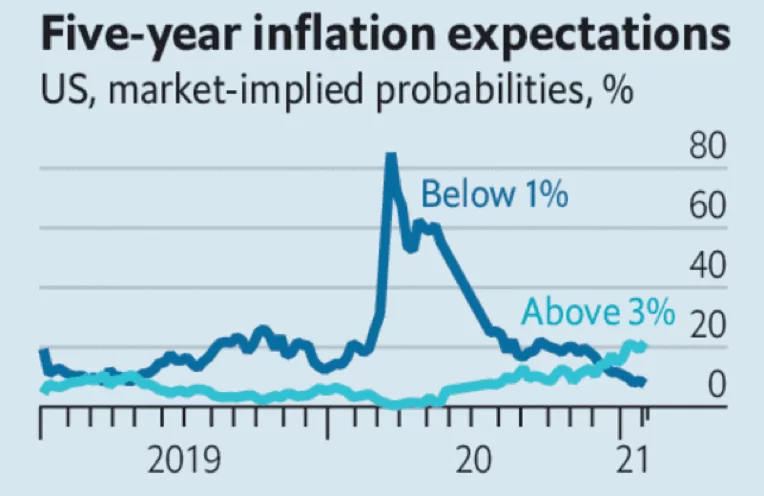
And US Fed is no different. With the rising inflationary expectations, the US FED have may have to tighten policy sooner than planned. This expectation has triggered a widespread sell-off in government bond markets — which investors worry could get worse.
The US 10-year Treasury yield, one of the world’s most closely watched interest rates, has risen past 1.6 per cent, up from 0.9 per cent at the beginning of the year, as investors sold the debt. Meanwhile, the 10-year break-even rate, a key measure of inflation expectations, now sits near its highest level since 2014.
With this spike in US yields and rising inflationary expectations, traders have worried about a repeat of the taper tantrum of 2013. The post-Covid period was marked by massive fiscal spending and substantial monetary easing by the US and other economies.
But as expectations of a stronger economic recovery have gained ground, inflation in commodities has been rearing its head. The possibility of inflation has also fuelled concerns that the US Fed will have to reverse its quantitative easing and raise interest rates sooner rather than later. This has given rise to the possibility of a new ‘tantrum’. The chart below depicts that the emerging markets have been spooked at the very thought of the new ‘tantrum’.
India, too bears the brunt of any such policy development in the US. The last time when US Treasury yields rose sharply in 2013, it triggered an outflow of capital from emerging market economies spread over several months beginning in May 2013.
In India, foreign institutional investors pulled out money from both equities and bonds leading to rupee depreciation by over 15 per cent. This had forced the RBI to raise interest rates to prevent the capital flight.
In the current times as well, with a massive government borrowing plan lined up for 2021-22, an oversupply of government bonds without a commensurate demand for them has pushed up G-sec yields. The inflationary concerns (rising crude prices) and the possibility of appropriate policy action (such as a rate hike) by the RBI are fanning the fears.
In the 2013 taper tantrum, the impact on the stock market was short-lived. This time, the markets seem overvalued and investors fear that the rise in yields can become the trigger for a prolonged market correction.
Nonetheless, investors need not panic. It’s important to embrace the volatility – both in equity and debt markets. Rising interest rates will benefit the short term debt instruments as the coupon will rise So, stay invested. Our Indian economy is rebounding on robust fundamentals to a sustained growth trajectory – those who stay in the markets – will surely be the ultimate gainer in times to come!
Best Regards
Dr. Tarunika Jain Agarwal Ph.D.
Alpha Research